Episode 76: High School Hobby Turned Edtech Solutions

Keywords
education technology, student innovation, classroom collaboration, edtech, Markify, entrepreneurship in education
Key Topics
Anthony Beckett's educational journey
Development and impact of Markify
Challenges and successes in edtech implementation
Sound Bites
"Why can't notes be on my Chromebook?"
"Markify supports account integration."
"Group work becomes teamwork."
In this episode of Under the Hat, high school innovator Anthony Beckett shares his journey from note-taking struggles to creating Markify, a collaborative classroom tool. Discover how student-led solutions can transform education and the future of edtech.
Want to learn more? Here are the links:
Steve, M.Ed. (00:23)
Hey friends, welcome back to Under the Hat. We're sitting here in episode 76 and we are super pumped and thrilled to be here with you. As always, I'm your co-host, Steve Martinez, and I'm joined by...
Sophie, M.Ed. (00:35)
Sophie Youngs, hey Steve, how you doing today?
Steve, M.Ed. (00:38)
I'm doing well. have ⁓ just have had good vibes with us closing down March Madness. ⁓ Super good engagement this year. I felt like the improvements we've made kind of really paid off in the sense of like what people got out of it, what the presenters got out of it. ⁓ But yeah, that's what's been on my mind lately.
Sophie, M.Ed. (01:00)
the research that we weaved into it this year. A little bit of a data geek, so I love seeing those numbers and why it's actually going to be working type of thing. ⁓ It was a good free PD over two weekends. It was really great.
Steve, M.Ed. (01:12)
Yeah.
yeah, yeah. And so for those that are curious, we have been getting the request of like Steve, Sophie, we're all those videos. And so we are working on something to kind of package it all up to post. And so you'll be getting that online. John over on the Edu Protocol side, he'll be getting that for those that are Edu ⁓ Protocol Plus members, I believe that's the correct verbiage. ⁓ So yeah, just stay tuned for all that.
Sophie, M.Ed. (01:47)
Yeah, super exciting. But today what's top of mind for Steve and me is how today's guest didn't just survive high school note taking struggles, he built a way out of them. While most sophomores were ⁓ just trying to pass classes, Anthony Beckett was already deep in the trenches building Markify to put the whiteboard on every student's desk. He spent over half his high school career refining this tool to make classrooms more inclusive.
taking his vision all the way to the big stages at ISTE and FETC. Now a college student, Anthony is proving that when we empower students to solve their own problems, the entire education system wins. Anthony, we are thrilled to have you here. Tell us about your educational journey.
Anthony Beckett (02:37)
Yes, thank you for having me, of course. And I feel like that just covered pretty much all of the main points. I'm not gonna lie, but yeah, I guess I can kind of take you back to the beginning in a sense. And so I was a high school sophomore student when I first kind of came up with the idea for Markify. Of course, it was nowhere near like what it is today. ⁓
But I was sitting in math class, my teacher was writing notes at the front of the room and it was a very traditional kind of lecture. ⁓ We were kind of copying the notes down onto our note sheet and whatnot. And all of a sudden, for the hundredth time, he erased the board before I had all of the notes down. And so that was kind when I first had the idea, you I've got a Chromebook sitting in front of me now. Why can't the notes that my teacher's writing up at the front?
Steve, M.Ed. (03:18)
Hmm
Anthony Beckett (03:28)
Why can't those notes be on my Chromebook where I can see it up close and even go back to when I missed? And so that was where it started. It kind of, you know, I spent the next six or so months building out a prototype of that. I had built plenty of websites and things before. And so that's kind of, I was always a big technology geek, of course. ⁓ But I built out a prototype. was called TeachCast at that point. ⁓
Steve, M.Ed. (03:34)
Hmm.
Anthony Beckett (03:56)
But when I started showing it to some of my teachers, the feedback, I mean, they liked it, but their big question is, why is this one direction? If I can write and the notes show up to students up close, why can't students write up close and it show up for the whole classroom? And so that's kind of when it started shifting and morphing into the Markify of today.
was I started, you know, I built that into it. And so now students had tools and the teacher could grant them editing access where students could come in and start writing on their Chromebook. And a big realization was the fact that this opened up the door and kind of expanded so many students comfort zones, right? Because a lot of students who were afraid to get up in front of the classroom and write on the board in front of everyone.
now felt comfortable answering things and participating in the class. And so from there, I kept building it out over my junior and senior year. Senior year of high school is when I really started getting it out into the world. spent most of my junior year just kind of rebuilding everything and freshening it up. But I launched Markify my senior year in my own school district, which was a really fun experience. ⁓
Of course, there was some struggles. The tech department did not want to approve it. ⁓ But when they finally looked through everything and found that I had done all the security precautions and all that that were required, they approved it. And I was able to get a lot of my own teachers and teachers at other schools using it. ⁓ Of course, I have to also call out and thank the EIC or Entrepreneurship Innovation Center, which was a fantastic program at my school district.
And they kind of helped me in the door in a lot of places throughout Tennessee, which is where I'm located. ⁓ But yeah, but I continued it after graduating high school. I did a gap year. And so I focused that whole year just on Markify seeing what I could do. But I think the biggest thing, which I'm sure we'll touch on more as you guys ask questions and whatnot, but I made the decision during that gap year or I guess last year.
⁓ to make Markify completely free for anyone to use. And so I ended up pivoting because I was just not happy. I went to a lot of conferences and a lot of schools and presented and there were teachers that were like, I love this, I wanna use this, but there's no way my school district's purchasing this. If they were to purchase this, they're probably not gonna renew it a year later and I'm gonna waste months learning something that I can't use anymore. So I ended up making it free. ⁓
But of course to please my mom in a sense, she's like, all right, you're not gonna make money off this. You gotta go to college. So now I'm a college student. the downside is I can't work on Markify as much, but I've gotten to learn from so many different professors here and kind of look at Markify for the higher education segment, while also looking at building out kind of the company side of things, which, know, I'm very much on the education end.
in the product end, I guess you could say more than the business end, but ⁓ it definitely has been fun and interesting kind of learning the entrepreneurship side as well, right? Of how can this turn into something sustainable that I could do as a full-time career or even grow into having multiple other people working at it, right? So yeah, that's kind of the whole journey up until now in a sense, ⁓ but yeah.
Steve, M.Ed. (07:36)
So can I just like, can I just say that ⁓ being someone that used to teach sophomores, I sometimes, yeah, sometimes it's like, ⁓ can you just put your name on your paper? ⁓ So when I hear your story, ⁓ it is insanely impressive and innovative. ⁓ And I do find it like inspiring in the sense of like, hey, you saw this need.
Anthony Beckett (07:42)
interesting twist. ⁓
Steve, M.Ed. (08:06)
⁓ and wanted to grow something ⁓ basically from scratch right and and and so I was kind of i'm kind of curious about you know What is this balance been like for you because like you you you are you are the ceo right? Like you're the ceo of mark fi you're you're an entrepreneur What's this but you're still you're still living? This life of a student like you're still a high school student, right? Like I just
I'm curious what you did. I just feel like it would be like this this interesting balance of Feeling grown up a little bit and doing and doing these these things that are maybe outside of what the norms are for For a high school and a college kid. I don't say kid with like a student ⁓ and But then also like there's also like the social components of all that right? I'm just curious what what this balance has been like for you
Anthony Beckett (09:04)
Yeah.
Well, first of all, thank you for the kind words. You know, I definitely get that a lot, but I think you'd be surprised. I'm seeing so many things. I still go back to my school district to present and I guess inspire, you could say, I guess. ⁓ But I've seen, I recently met a student at my old school who was starting his own kind of ed tech.
tool and product to solve a different problem that he had in class. And so I definitely think, I think some of that's probably AI related ⁓ with all the vibe coding and whatnot. But I think we're seeing, we're kind of entering a new era of students solving problems and building businesses and doing things. getting into your question on balance, the, I guess, short and unfortunate answer is there's no balance at all. There is like zero effective balance.
Steve, M.Ed. (09:35)
Mmm.
Anthony Beckett (10:01)
⁓ I pretty much put Markify over everything else because I really did enjoy doing it. I'm definitely a workaholic kind of person, I guess you could say. ⁓ But there were many days where I barely got by in school and kind of passed classes in a sense. so... ⁓
You know, when it came to my junior year, I did a bunch of AP classes because all of, know, I like to hang out with people smarter than myself. So I had a lot of friends who were your top of the line gifted kind of students, 37 AP classes. ⁓ but I kind of realized my junior year, like if I'm going to go to a top college or something, like I've got to do all these classes. And I ended up partly because of Markify, partly just because I'm not that kind of
academic person, I guess, I did not excel at a lot of those classes. You know, I passed, but I didn't, you know, get 99s and all of those, all the, I didn't get five AP score on most of the tests. And so I kind of realized at the end of that year, it's kind of like, do I want to continue trying to put as much as I can into these AP classes and school and do my best to try to go somewhere? Or do I want to kind of
gamble everything on Markify, which is something that I actually enjoy and like doing. And I went that route. And so obviously I picked Markify. And so my senior year, you know, everyone around me kind of thought I was crazy. Like, why are you working on this and not trying to focus on school? But I did the, the bear that I could, know, the least amount of work that I could my senior year so that I could focus everything on Markify. Of course I did the gap year and that was
just phenomenal, you know, not only for Markify, but learning kind of about myself and what I like doing. ⁓ But the balance has always been very much on Markify. And then when it comes to the college era, I guess, you know, I struggled a lot. I could tell stories all day long about the craziness that I have experienced here. ⁓ When I first came, I was obviously in a dorm and just the craziness.
that I experienced, all of the elicits that you can imagine were present, but I was never really a party kid in a sense. And so eventually I was able to move out of that environment and get an apartment where I am now. And that's been great because I've been able to once again kind of put the focus back on Markify and back to being able to work and do the things that I need to do for it. ⁓ But it's definitely an interesting thing because
I think a lot of people, get excited for like a college party or something like that, right? They're like, let's go party, let's go get drunk or whatnot. But for me, I just am not excited by any of those things. I'm excited sort of what you were saying, Sophie, at the beginning with the analytics, I'm excited opening up Markify and seeing a thousand teachers using it a day and benefiting from it, then hearing feedback from them. And so I think that's why I'm able to justify working so much on Markify.
⁓ But yeah, I pretty much do what I got to do the past college classes and then I put the rest of the time in Markify. Sometimes not enough to pass the college classes.
Steve, M.Ed. (13:26)
⁓ Yeah, this is super interesting. like like I have and this is this is where I believe that you know more authentic learning experiences need to be just across every classroom, right and You were probably in the situation where and maybe not but like you you either were were at a fight to to build something like markify
Anthony Beckett (13:45)
Exactly.
Steve, M.Ed. (13:56)
or you just had the means to do so, right? And there's so many, like you kind of mentioned, like there's others that are out there that are looking to build EdTech solutions. ⁓ But like that very world, that work could start in classrooms, right? And to me, that's where, when I hear and see pushback on whether or not project-based learning is effective, I'm like, this right here.
Anthony Beckett (14:14)
Absolutely, yeah.
Steve, M.Ed. (14:24)
This right here is an example of it becoming real life and not just something that ends at the end of a great book. And so I don't know, I just applaud you for putting yourself out there and doing that work. I may have missed.
Anthony Beckett (14:40)
Real quick,
⁓ it reminds me, I did a session with Thomas Furman, who I don't think is too prevalent in the space, but I did a session with him coming up probably a year ago now, and we did it on project-based learning, and it was on that very topic of project-based learning doesn't have to mean you do a quick project for a week, and then the assignment's open.
Like this can be something that lasts a whole school year. This can be something that lasts multiple school years. This can be something that in my case turns into a business in a sense later. But that's what gets me so excited. I mentioned at the beginning about the EIC opportunity that was at my district. You know, that's something that's starting to show up at more schools than I think needs to be. And, you know, we're seeing a lot of stuff come out and a big thing from that, like not a whole lot of people leave that.
running their own business like I did, but, ⁓ but a lot of people do leave programs like that, confident in presenting confident and marketing and things like that. but I think the more skills and really not even just entrepreneurship, but kind of CTE in general, or even outside of CTE, the more skills that kind of can be taught, I think, you know, during K through 12 that you can come out and
go to college or even not, you know, not even go to college and have those skills and kind of knowledge. I think that's ⁓ kind of what the future is looking like, right? And I think that's what it needs to look like.
Steve, M.Ed. (16:15)
Yeah. Yeah.
may have missed this earlier, because like in the middle of your, not in the middle of it, like you were explaining because like your journey and everything else, my daughter is out there, I had to go handle that. You may have touched on this, like, like, where is, I don't wanna say the crossroad or maybe like how the two are related, but what you're doing as a college student with respect to your degree, like how is that aligning to Markify?
Are you like finishing college and then maybe branching out? Like how are you taking that college experience and helping that lift up Markify like later on? I'm just curious how the two are intertwined. Yeah.
Sophie, M.Ed. (17:04)
What's your degree?
Anthony Beckett (17:06)
Yeah,
yes. There's a long way when did you ask me that? I mean, well, I guess I should say, and I kind of mentioned this part earlier, but I was really not that excited to come to college. And I still am not a huge college fan. not because I don't think college is good. Like I think for most people, it is something that they should go do. But just for myself, I was never that excited about it. Even before
I thought of Markify being a business, right? I was ⁓ still wasn't that excited about college. I felt like everyone around me when I was starting off high school is like, ⁓ college should be great. You'll find your people. You'll love all that. But ⁓ I would say that certainly hasn't really happened ⁓ in a lot of ways. ⁓ But the reason I bring that up is my focus is still mostly on Markify, but college has been good for kind of
Continuing the work on it while having a comfort layer, of course, like I'd mentioned, my mom is a very big advocate of college, right? And she's grew up her whole life ⁓ in a lot of ways disadvantaged and wanted her kids, me to have the best chance of success. And so she had always looked at college as being the way that do that. ⁓ And then I also think part of it is she never really fully understood
Markify or what it even was used for. Right. So she was always wanting me to go to college. So I promised her during that gap year that I would go to college and at least try it out and see what develops from it. Right. Now, in terms of, of getting a degree or not, it really just depends how Markify goes, right. If it works out and it's, you know, I'm having to go to too many conferences and whatnot as we were.
talking about before starting this meeting to sustain it, then I put Markify over college. Like I'm not even afraid to really say that. But if it makes sense to get a degree and finish that out, then I'll do that as well, right? I'm open to whatever's gonna work out. Now, the degree itself, currently I'm studying business management. So I might change that. I also might do a minor in education just because I wanna learn more.
about teaching and education in general. ⁓ But I will say it has been fascinating kind of learning about management and in the future, if I was to bring on people with Markify, ⁓ what that would look like, right? And how do you manage a team effectively and make everyone feel? The first class that I did in the first semester was ⁓ kind of talking about how do you motivate employees? How do you make them feel?
Sophie, M.Ed. (19:47)
Okay.
Anthony Beckett (20:00)
part of a company and not just getting a paycheck, but something that they want to actually wake up and show up to, right? And so it's definitely been fascinating learning about that. So like I said, it just depends how it goes, but I do think one factor that might make the decision is they are very much pushing internships. ⁓ I think a big kind of theme of today is that a degree is just not enough anymore.
I guess it's, you know, as, we've always known, right. It's, it's a piece of paper that says that you've gone to these classes, but experience is very quickly becoming the new kind of metric, right. Of what employers are looking for and what everyone's looking at. And when I'm doing Markify, there's just no room at all to do internships. So at some point it's, it's going to get to a decision kind of, you know, two paths in a sense.
Steve, M.Ed. (20:37)
Mm-hmm.
Anthony Beckett (20:59)
keep doing Markify, keep working on that exclusively, or start looking at those internships and then Markify. By no means would I ever stop working on Markify, but it would kind of quiet down and not be the main focus anymore. But at least as of now, I'm more looking at the Markify path, of course.
Sophie, M.Ed. (21:19)
You mentioned what it would look like to hire people and things. And I'm wondering if you had thought about like what department would that first hire be? Would it be in sales? Would it be in marketing? Would it be in development so that you're not building as much? So what do you think that first hire would be?
Anthony Beckett (21:37)
Well, it's hard. will say I did actually bring on somebody to Markify a partner, not a hire per se, but someone to kind of help out with some of the business end of things. ⁓ and so I think development is pretty much covered for now. I'm sure eventually to reach a point where I can't focus on that. ⁓ but I would certainly imagine some kind of marketing sales kind of direction probably would be the first person.
⁓ but we'll have to see a big part and kind of why Markify has been sustainable up until now has been professional development. And so I could see bringing on some kind of trainer to kind of train people on Markify and, things like that, and also get paid from the school districts to do that PD, ⁓ to kind of keep getting Markify out there. But it really just depends what's needed in the moment, I guess. For what I'd get, but, most likely somebody more on a
a people end, I guess you could say.
Steve, M.Ed. (22:40)
Yeah Yeah, I mean like it's all about like It's that investment right if you're invest that initial investment what's gonna get you to grow and That's yeah, that's certainly interesting You had you had mentioned before about like, you know having a minor in education learning more about education just curious if you have put any thought into like
going into teaching yourself, right? Cause like that would, that would give you a whole lot of insight of, yeah. And, it's not like you have teach forever, right? I was just like, as you, it's just a thought that occurred to my head. I'm like, ⁓ he could even go like, you could even go teach CTE, right? having that, those industry hours. Yeah.
Anthony Beckett (23:14)
Yeah.
That's what I was about to say.
⁓ I think the first thing I'll say, I spend a lot of time looking into education and trying to understand it. That was a big focus of mine. Well, it's still a big focus, but it was a big focus during high school. ⁓ I met with pretty much everyone in my school, I want to say, at some point, and met with them and learned from them about not just Markify.
I mean, obviously I'd bring it up and what are your thoughts on this, but what are the problems that you're experiencing right now? ⁓ But I think the hard part and has always been the hard part for me is I'm not a teacher, right? Trying to build Markify. And so I very much rely on what people using it say and even what people who don't use it, but have ideas ⁓ for what problems they experience. ⁓
You know, the help me kind of guide where I'm going with it. Right. But I I've always treated it like I am not the expert. ⁓ when I was at NC ties two-ish weeks ago, yeah. ⁓ I did a session. And I, it is a phenomenal con, especially this year. It was, it was amazing, but I did a session at the end and I opened my session with like, look, I'm not a teacher. I'm not here to tell you how to teach or, what to, what strategies to do.
Sophie, M.Ed. (24:36)
That's a great conference. Sorry, go ahead.
Anthony Beckett (24:53)
⁓ that's all of your jobs. And so the whole session was kind of, I don't know if either of you have heard of the show Pluribus, but I brought that up at the beginning and it's kind of like the show is about a hive mind. And so essentially everyone on earth kind of connects together into one brain with all of the common knowledge. So that's kind of I told everyone. We're gonna, yeah, it was a crazy show, but that's how I opened it. And I told everyone like,
Steve, M.Ed. (25:13)
That's crazy cool.
Anthony Beckett (25:22)
We're going to use Markify. We're going to collaborate on it. And we're going, hopefully by the end, all of you will have learned something from someone else that was in the room. Right. But I want to make it clear. Like I've never thought of myself as an expert. Now in terms of teaching, I think I would love teaching. I've done a lot of summer camps kind of teaching and I've always been in the STEM direction. So kind of the CTE area. ⁓ but I love teaching programming.
Steve, M.Ed. (25:31)
Mm-hmm.
Mm. Yep.
Anthony Beckett (25:50)
One thing that I did a lot before coming to college, now it's a lot more difficult here, but when I was home was I went to a lot of STEM nights and so I kind of did small classes of teaching robotics there and getting students interested in it. And if I wasn't doing Markify, if I was starting like a brand new company, I guess, I would probably wanna do something in the STEM direction just because in a lot of ways I think that's what I'm most passionate about.
specifically when it comes to education. On the other hand, I could not be a math teacher at all. That would be hard. But yeah, something STEM or science route, I'd love to teach.
Steve, M.Ed. (26:27)
I understand, yes. ⁓
Yeah.
Sophie, M.Ed. (26:36)
You know that ⁓ in STEM is math, right?
Anthony Beckett (26:40)
But I'm
not not the math part. I guess that's a good good focus
Steve, M.Ed. (26:44)
He's
gonna stay. ⁓
Sophie, M.Ed. (26:47)
Eheh
Anthony Beckett (26:48)
Now math is very important, by all means. But I could not teach it. That would be...
Sophie, M.Ed. (26:54)
You know, Dr. D we had on here recently, she made a comment that I'm like really loving and it is like, it's okay to know what you're not good at and to say that that's, I'm not good at that. So you and Steve can say that you're not the best at math, but you are still math people coming from a math teacher. You are still math people. ⁓
Anthony Beckett (27:17)
No, no, I like
math a lot. It's just when it comes to teaching it, it... That would be hard. Yeah.
Sophie, M.Ed. (27:20)
Teaching it, yes. It's different.
Steve, M.Ed. (27:25)
getting others to understand what's in your brain. ⁓
Anthony Beckett (27:28)
Exactly. And for some
reason, I'm really good at that when it comes to computers and programming. I've always thought I'm good at kind of dumbing it down in a sense for someone to understand so that they can build a foundation. ⁓ But I think that's the hardest part of teaching, right? It's not just knowing the knowledge. I mean, had not going to mention names, but I had a professor here who was just like this. He knew all of the math that you could imagine. mean, he was studying like here at
theoretical math. But when it came to trying to explain it, that was kind of where a lot of it fell apart, right? So I think
Sophie, M.Ed. (28:07)
Well, yeah, and
it's not even math teachers that are like this, but it's you go to a university ⁓ presence. They know they are an expert in their content area, but many of them never went through an education program to learn how to teach. So, and that's a struggle that we go to at any college or university that you go to. They are experts in their content area, but they were never educated on how to teach. And that's why they have the...
Anthony Beckett (28:09)
No, it's everybody. No, no, no. It is everybody.
Absolutely.
Sophie, M.Ed. (28:35)
There's like a little internal teaching and learning offices or coordinators or whatever in universities to help those teachers learn how to teach. ⁓ And that's whole thing all in itself.
Anthony Beckett (28:51)
But just learning the strategies and whatnot. And it's a whole other thing. I could talk about it for too long, so I won't. But ⁓ my current English teacher, professor here, ⁓ she just landed her first teaching role. And so it's an exciting dynamic, I guess, being at college. Because as much as I hate the bad parts, like a lot, at least the bad parts, in my opinion, I know for most other people, they're not. ⁓
But it's been great. like, I've liked the entrepreneurship program here, but I've loved meeting future teachers and talking to them and getting their thoughts on Markify and what they struggle with. And we're entering kind of a new era, I guess. I feel like I've said that a lot. Era is the word of the day. But we're entering a new world where a lot of the new teachers have used technology their whole life, right?
you know, now they're looking at how can I incorporate that into the classroom, into teaching. ⁓ And I also think it's going to be a struggle with technology with so many students being engaged all the time with their short feed video, right? And so it'd be interesting to see kind of where ed tech and education in general goes.
Steve, M.Ed. (30:01)
Mm-hmm.
Well. ⁓
Sophie, M.Ed. (30:11)
And Steve and I have a lot of
thoughts about ed tech and integrating it into the classroom and how to keep their attention. And some of it isn't necessarily to use more tech. Some of it is to teach better, do better activities, do PBL activities, do more engaging lessons that the core of it is more engaging. It's not the tech that makes it engaging. It's what you're asking them to do that is more engaging.
Steve, M.Ed. (30:18)
Yeah.
Anthony Beckett (30:38)
No,
I don't think technology alone. I've, I've yet to see a case where technology by itself has made a meaningful difference with teaching. Right. I think when it's used correctly, it can do a lot, but I think there is a lot of teachers who, unfortunately, the thing that I get, cause I've gone to so many schools and districts and presented of course. So I've seen a lot of this. ⁓ when, when you were talking earlier, it's okay to not know.
what you don't know, right? Or what you're not focused on. Yeah, it's the opposite here. I feel like I know this very well. I've gone to a lot of schools and it's not that teachers don't want to use technology. It's that they were not really educated by their school on the technology. And so I've had so many, you I was talking to a teacher not too long ago. They're like, they put this interactive board in my room, never showed us how to use it.
outside of just writing on it like a normal whiteboard. So what was the point, right? ⁓ So I think that's where a lot of the struggle comes from. I also think it's really easy to walk into a conference, right? It's really easy to walk into ISTE or FETC and be like, my goodness, EdTech is the biggest thing in the world. This is being used everywhere. But when I actually go to schools and talk to teachers that aren't at these conferences, I would, I mean, I don't know the
the actual numbers off the top of my head, but I would say only around 10 % of teachers really use EdTech for teaching, right? They might use a grade book, right? They might know how to assign something in Google Classroom, but they don't actually use it for doing the actual teaching side of things. And that's kind of been a big focus of mine with Markify is how can I make something anyone can learn, anyone can access, once again, why it's free.
Steve, M.Ed. (32:13)
Yes.
Sophie, M.Ed. (32:14)
Yes.
Anthony Beckett (32:34)
And they can start using it in their classroom to engage students and make learning more accessible by putting it on everyone's desk. So that's kind of been a big thing. But like I said, it's so easy to go to these conferences and think this is the biggest thing ever. But when you really look at it, I really don't see that many teachers effectively using technology. And I know having recently graduated, I would say out of all my years of school, maybe only two or three teachers ever
really effectively use technology. Most of them still did it the way it's been done for 60, 70 years, which there's no problem with that. But it's, how can we do stuff? Well, there's no problem specifically with old technology, right? And there's been a big theme of, should we just get rid of all the screens? But I think what we should be looking at is how can technology do things that couldn't be done before?
Right? How can we do something that a whiteboard or a piece of paper couldn't do beforehand? And I think a lot of the current ed tech is just trying to, to replace something that already existed. Right? You know, this worked on paper, but let's do it on computer now. And so I think, but the focus and some of this is happening with, with AI, but I think now the focus, how can we do things that just couldn't be done without a computer, right? Without technology and how can we do use both of those?
to better engage students in a time where students certainly need a lot more engaging, I think, because they're getting so much stimulus from technology and things on their own, right? ⁓ That's kind of my take on it, I guess. ⁓
Steve, M.Ed. (34:16)
So there are so many thoughts flying through my head with that. But one that is actually kind of stapled in there is Sophie and I have this EdTech experience and I don't mind sharing this, but there's, always felt working at Cami, there's like all this emphasis for like, we're preparing for FETC, we're preparing for ISTE.
Sophie, M.Ed. (34:19)
Right.
Steve, M.Ed. (34:44)
preparing for Q right like these tcea like these more these more powerhouse kind of events ⁓ and in the back of my mind i get it like all they i'll say it the end goal there is lead generation is new business that's the that's the angle for better for worse for dirty or or or whatever ⁓ but in the back of my head as an being an educator there like a true educator i'm like
Sophie, M.Ed. (35:02)
Mm-hmm.
Steve, M.Ed. (35:13)
Those people at ISTE, those are not the people that need Sophie. Those are not the people that need Steve. Like it is in more grassroots, like kind of what you're talking about, Anthony, of like the teachers that are actually going to ISTE, those are not the ones that need support with integrating technology effectively and purposefully. It are the ones that are not there that are using the technology maybe in more archaic or
only for productivity purposes. But those are the folks that like need that kind of support, right? And so for me, that was always like, yes, the big shows are nice and there are a lot of energy. But what are we actually doing to help teachers on a more like national global scale?
Sophie, M.Ed. (36:02)
and the national conferences, those huge regional conferences are kind of expensive to go to. the ones that districts, a lot of the districts that I worked in, they don't have the funding to send teachers to those. And if they do, it's like one, maybe two, and then they're supposed to come back and spread that information maybe to their entire state ⁓ because they just isn't, there isn't a button off there. So.
Anthony Beckett (36:16)
Thank
Sophie, M.Ed. (36:29)
the conferences in my area, I'm in West Virginia, that teachers tend to go to are the state-ran ones. So if you're gonna penetrate my state and maybe even some Tennessee states, you're gonna go to the ones that are ran in state because, Tennessee have those, was it Kentucky that has like, ⁓ Stephanie went on a road trip, I don't remember if it Tennessee or Kentucky, and it was like four days and each region had basically the same conference, but they like.
Anthony Beckett (36:45)
salute with
Sophie, M.Ed. (36:58)
went to each region and that's how you're going to reach the majority of those teachers. It's the ones that like the districts are putting on. It's the ones that the state is putting on. It's the one that the regions are putting on that most of those teachers that need the most support are going to see the new stuff because I can't tell you how many teachers that I know that aren't on X that are not in groups on Facebook that are not
Anthony Beckett (37:00)
I don't think it is.
Sophie, M.Ed. (37:25)
They're only doing the tech that is required by them to use because they have to, because the district is saying you have to. They're not going out and exploring other tech to see what could be done.
Anthony Beckett (37:38)
Well, what I think you're really hitting on, and I'm sure you know this very well, having gone on the exhibitor end of those conferences, but you know, the big conferences are not really geared toward teachers. I mean, there might be some that show up, but they are geared toward the administrators, the tech coordinators, and a lot of it, I don't think I'll get in trouble for saying this, but a lot of it is ⁓ very much how can we sell
And like, I won't mention names of companies, but I saw companies on that floor, and I'm sure you've seen this too on your own experience, they, their only goal was how can we get this superintendent or this administrator to buy this without even looking at teachers using it, right? You know, they're just, can we look appealing enough that they buy us? And there's not even any focus on the actual integration end of things, right? It's just focused on.
Steve, M.Ed. (38:34)
Mm.
Anthony Beckett (38:36)
getting them to purchase it, getting that contract, getting that purchase order in, and that's it. And I remember my school district, I remember it very fondly, they've spent so much money on technology. I we were very, I went to a very fortunate school district my middle and high school years, lots of wealth, lots of money, and they spent millions on education technology. Very few teachers really used it.
I mean, very few. Our school district bought Kami, for instance, for everyone, pretty much, for all of the teachers, but I can only think of maybe five to 10 out of the like 90 or so teachers at my high school that used it. So once again, that comes right back around to what I was saying before about 10 % or so of teachers really using this technology, but there's just not a lot of focus on the integration.
Now this year was the first time I went, or I guess, yeah, this year, this is the first time I went and exhibited at FETC. Up until then, all I've done is small state conferences because of what you said. That's where I've had the most success. When it does come down to money, because at the end of the day, you know, it's a capitalist country, right? It comes back down to running a business. ⁓
It's where you get the most bang for your buck in a sense, right? We're going to those small conferences and getting teachers using it. ⁓ but you know, one of my favorite conferences to go to is ACTM, ⁓ Alabama conference of teachers in mathematics. ⁓ but it's on math. know we're coming back to math, but, but yeah, it's one of my favorite conferences. was invited there thanks to someone that I knew that his
⁓ somebody in his family, I can't remember, but I knew somebody in my school district who then someone in his family tree at some point goes to this conference and helps run it. And so he invited me to it ⁓ two or so years ago. And so that's one of my favorite conferences though, because it's all math teachers pretty much. And there's very little technology. think when I exhibited there last year,
It was me and one other group, CNG, that were, we were the only tech companies there, I guess. But I would say 95 out of 100 people, you know, come and buy, like they didn't use, they didn't really know any technology, right? You know, this was a very new space for them. But I will also tell you, I had a session there, it was packed. I mean, I want to say there was 40, 50 people there.
So they want to learn the technology, they want to use technology, but their school or their district is just not providing the resources to teach it to them, right? And get it in front of them. They might be doing PD on how to engage students, but are they doing, you know, a PD on how to use this technology, how to use this tool? So.
Sophie, M.Ed. (41:36)
Well,
And like being, I used to be a district coach. So like I've even seen that side of things where it's like, teachers want to learn how they can do it, but the school district has like their hands tied on what they have to do PD on. So they are limited on time. And then do they have the funding to provide the PD that is quality? Some districts don't have coaches like me and some districts have cut coaches because of funding cuts and they have.
a teacher shortage, so they're putting their coaches back in the classroom to fill rooms. ⁓ It's one of those things where they know they need to do PD, they know their teachers need to learn more, ⁓ but how do they get it to them? And it's a quality session type of thing. So ⁓ it's a conundrum, it really is, because they have limited funding and they have limited time and teachers are already tired.
just juggling what they have. It's like, in the long run, this is gonna help you out and juggle less, but do you have the bandwidth to learn it to begin with?
Anthony Beckett (42:51)
Well, and then you add in,
then you add in the whole other side of things. And this is what I, deal with quite a bit with teachers is like, am I going to learn this new tool? And then tomorrow they pull the rug out from under me, right. And they, up the price or they add a price or my school district decides to block it or the school district doesn't renew what they bought. Right. And so, so many of the teachers at my former school district, that's exactly what happened.
Sophie, M.Ed. (43:07)
Yeah.
Yeah.
Steve, M.Ed. (43:15)
Thank you.
Anthony Beckett (43:20)
where they spent all this time, know, the school district actually did PD and forced them to learn this one tool that I won't name because I don't want to get in trouble, but forced everyone to learn this one tool. And then the next year they completely pivoted to something else. And all of these teachers were like, just spent all this time learning this and getting familiar with this program. And it wasn't just a program, it was curriculum as well. So I just spent all this time learning this curriculum. And now we're pivoting to something completely different.
Sophie, M.Ed. (43:50)
Yeah.
Anthony Beckett (43:51)
doesn't make most too excited to go to a tech conference, right? And start learning new things.
Steve, M.Ed. (43:51)
I was just having...
Yeah, I was just having this conversation yesterday with someone I won't I won't say the company ⁓ But my college where we just wrapped up a pilot right for a solution and We were having a hard time getting folks to like in different departments right because it would serve like a wide net of things Just getting like we had one department we're like
They felt uneasy and this is not me like being gossipy or like like it's it's this is a real thing where like they don't feel comfortable investing time into a tool that may not be purchased. But then it's that balance of like, well, if you don't try it, it's hard to justify to buy it. And so it's like this it's forcing teachers. Yeah. Yeah. And it's like and
Anthony Beckett (44:49)
Absolutely. I've seen that myself plenty of times. That is very true.
Sophie, M.Ed. (44:49)
Catch 22.
Steve, M.Ed. (44:54)
And that happens more often, less often in my space at the college level, but certainly in the K through 12 of just like, teachers are like, I'm not gonna build curriculum in something. I'm not gonna put all, build all this stuff in Cami ⁓ if I don't know if we're actually gonna buy it, right? And so it's a tricky thing.
I would like to spend a little bit of time though, Anthony, talking about your tool itself though, for what it is. Because I came across it around the time that I quote unquote became an edgy guardian, even though I didn't finish the application process. They just still let me in. so, and I looked into Markify and so I've been using it on and off for a little while now and
at my college, my colleague of mine, ⁓ the coordinator of CTE, she was like, hey, I have to teach this class, the CTE class, and I need them to collaborate, not on a slide deck. And she was like, I don't have a Cami license, so that's out the window. She got into Padlet and she was like, it's just way too much. I need this like, it was like hours before she had to teach. And I was like, let me show you something. And I gave her Markify without,
Even a whole lot of coaching. She was like, ⁓ this is it. And I'm not saying this is it in the sense of it like, it only does this. I'm talking about like learning it, like it being intuitive. And I, and I, and I, and I realized there are other use cases on it, but like the thing that I really appreciated about it was just the collaboration piece and how thoughtful it was from a classroom management.
piece even like where it's like, ⁓ I can feature control if I can use that term of like control what they what they can edit what they can't. And so just interested to hear more in terms of like what people don't know about it possibly and maybe like what is fairly new.
Anthony Beckett (47:07)
Yeah, yeah. And so I feel like you just, you hit it on the nail pretty much hit the head of the nail with your story there. I mean, that is pretty much in a lot of ways why I work on it and do it is, you know, hearing stuff like that from teachers. You know, the exciting thing I'll say really quickly was this year at NC Ties going, going back there, it was so exciting because it was the first conference that I've gone to where
people knew about Markify and like really used it. And so most conferences that I go to, you maybe there's like a couple of people that have heard about it. Maybe three or four that use it somewhat regularly. And then maybe there's some edgy guardians who are really supportive, but that's about it. But NCTize, I'd say probably 70 % of the people coming by already knew what Markify was.
and a good number had already even heard of it before. But, wait, I mean, it was.
Sophie, M.Ed. (48:10)
That's so fulfilling, right? Like you're
doing something and like people already know about it and they're like, yeah, I market. Like that's really fulfilling, right?
Anthony Beckett (48:20)
And it was just, was so interesting to hear how people were using it and what they were doing with it. A lot of it, of course, wasn't even stuff I had anticipated, right? ⁓ But kind of hearing, you know, how people had used it and then showing them the new stuff, which I think would be exciting to talk about in a minute. But, but, but yeah, so there's a big focus there. I think a big part of that too is Wake County, which is one of the largest school districts. ⁓
Sophie, M.Ed. (48:49)
Mm-hmm.
Anthony Beckett (48:50)
they actually rolled it out district wide. And the main reason for doing that was, well, partly because it's completely free, but also because of what you were just talking about, Steve, with it's easy to use and they were able to get it in front of their teachers quickly. Their problem was that they had put interactive boards into almost every single classroom, right? And so very common story, I guess that's pretty much what all school districts seem to be doing. But they put all these interactive boards and most of the teachers,
were just using those boards as a normal whiteboard, right? They were just using it like a digital version of a whiteboard, not really benefiting from it. ⁓ But these boards were getting old and the company, which I will not name, ⁓ they, feel like that's a common theme, this show. Like, will not name.
Sophie, M.Ed. (49:38)
They're
sun setting their interactive, like the whiteboard, right? Yeah.
Anthony Beckett (49:43)
Exactly.
So they, they have decided they're no longer going to be updating their built-in whiteboard tool. And the tech department had to upgrade all of the interactive boards for security reasons. And so they very quickly kind of became the villains because they took this tool away from all of their teachers and won't name the company, but as you can imagine, their goal is, well, you need to buy new boards for all your classrooms. Because yeah.
Sophie, M.Ed. (50:10)
That's an expensive lift. Extremely.
Anthony Beckett (50:13)
So
they had been looking, the tech department, they had been looking for something that they could drop in for all of their teachers to use so that they could continue using their board. And Markify, like I said, it was free. And they told me too when I met with them, like, we could pay for this. I mean, we've got plenty of money. We could give you hundreds of thousands of dollars if we wanted. The problem is we need board approval to do that. And that's going to take five to 10 years to get.
And so I told them like, look, it's a free tool, roll it out. We can look at doing PD and some other things later to figure out how the servers and all are gonna be paid for. ⁓ But they were able to roll it out district wide and their teachers not only had a new tool that they could just start using, ⁓ but they had lots more that they could do with it, right? They had the collaboration features, they had everything else. And so...
That was what was most exciting, I think, was not only did they have a new tool, but they could do new things with it, right? And so I think last that I looked, about 15 or so percent of their school district now uses it, which is pretty crazy adoption. That's just not something that happens. 15 % being like almost 2000 teachers, I think. And that happened in six months or so of time.
So that's, yeah.
Sophie, M.Ed. (51:41)
So and it's only gonna grow, especially as you
add PD opportunities in. And you've got some champions right there close that can go to the PD for you.
Anthony Beckett (51:45)
Exactly.
We've
actually already talked about that and so Christie and Dave are very open. They actually came by the booth and started presenting at the booth for me. ⁓ Okay. Well, I'm gonna just go use the bathroom go get a coffee or something. You guys keep exhibiting for me
Sophie, M.Ed. (52:07)
They
got it. Yeah. They're fantastic.
Anthony Beckett (52:09)
But, ⁓
but yeah, but anyway, I I got distracted, I guess, talking about Markify itself as a tool. I mean, I feel like a lot of it's already been covered, but the goal really is to just be the most easy to use whiteboard tool for the classroom. And as I'd said earlier, the goal, you know, kind of the secondary goal is how can things be done on this that couldn't be done on paper or couldn't be done on a normal whiteboard. And so.
you know, when I'm at a conference, excuse me, when I'm at a conference, I'm always, ⁓ you know, a lot of people who come by are like, okay, so it's the goal to like get rid of paper or something. I'm like, no, the goal is the students got the notes up close. They've got the paper next to them where they're actually taking their notes because paper is going to be better to remember things with. ⁓ And they're using them together. You know, the goal is not how can we replace the analog and put in the digital here.
Similar to that, the goal is not to get rid of a normal whiteboard, right? I feel like a teacher, if you want to do an activity on your just standard whiteboard or even chalkboard on the wall, do it, right? ⁓ What the goal is to do is how can we make collaboration safe, right? How can we bring this into the classroom? How can we make it where students can work together as a class to accomplish assignments and do work?
And I've seen so many good use cases of Markify for that, from Socratic seminars to project-based learning even. And Socratic seminars being some of my favorite, because I've seen there's one teacher who showed me at NC Ties, he had put out titles for like characters, themes, all these different sections. And then all the students could all hop onto the same board and put sticky notes underneath it for all, you know, what the main characters are, they...
Steve, M.Ed. (54:01)
Mm-hmm.
Anthony Beckett (54:03)
the theme is. ⁓ But that's something you just can't do on a normal whiteboard, right? It doesn't mean a normal whiteboard is bad, but you can only have a couple people up on that whiteboard at a time before they start getting in each other's way. Another thing is the normal whiteboard on its own doesn't save the notes for later. And so by being digital, all of these notes are saved. But then by far the biggest focus of Markify, at least up until now, has been the safety end of things.
How can we do collaboration without chaos is what I like to say. And so the idea is with Markify, you have full control over who can edit and when. And so you can grant editing to just specific students. You can grant it to everyone. You can take it away at any point. Students cannot by default edit each other's work. They can only edit what they add to the board. A relatively new feature I've been rolling out is the ability to
unlock certain elements. So most of the board can't be modified by students, but then maybe there's some titles that you want them to move for like labeling a cell. Those you can unlock and say, hey, anyone can move these and now students can move and put those, but they can't like delete the PDF of the diagram, right? And so it's very much about the safety end of things.
Steve, M.Ed. (55:25)
The sticky notes. I don't know, maybe it's because I long time came user, but I'm like the sticky notes.
Anthony Beckett (55:26)
Yeah.
I actually do not know how Cammie does not have sticky notes. It is unbelievable to me. I actually brought it up with Hengie when I talked with him ⁓ at some point in the last two years. I told him like, you need sticky notes and they still don't have them. So I tried to give them a free card for what they had, but it's like.
Steve, M.Ed. (55:53)
Yeah. ⁓ Yeah. So just again, big shout on what you're doing, Anthony. Just really, really appreciate it. ⁓ We are coming down ⁓ close to the hour here. We have about five minutes left. We do ask all of our guests the same question, but curious what you have to say. It could be something that you've kind of touched on before, but.
⁓ What is under the hat for you? What is top of mind ⁓ in education? What is something we should be talking more about?
Anthony Beckett (56:28)
Yeah, well, I've actually when you asked that or brought that up and said you were going to ask that question at the beginning, I thought of something and I've saved it to the end because I thought we should have like a special moment, I guess. ⁓ But I don't know. But I didn't just want to repeat something I'd said earlier or something like that. ⁓ I think the big thing that I'll try to really quickly say, ⁓ I've been working on a brand new tool.
Steve, M.Ed. (56:41)
Mm.
Yeah.
Anthony Beckett (56:58)
for over two years now. And so alongside Markify, it is part of Markify, but it's kind of its own product, its own tool in a sense. ⁓ And it's first launching, I guess you could say Monday. And so I'm rolling it out Monday only to alpha, only an alpha, it's still got a long way to go and only to a subset of users. So it's not gonna be for everyone yet ⁓ because I wanna make sure that I get it really right. ⁓
just because I think when I say what it is in a second here, you'll understand why it's very important to get this right and to really be careful with how it's used and what people do with it. I don't just want to roll it out to 10,000 people all of a sudden and have a bunch of issues or something. ⁓ But anyway, this new tool is called Markify Breakout. And so as the name kind of might imply, it's essentially
Steve, M.Ed. (57:34)
Mm-hmm.
Anthony Beckett (57:55)
It's built on the same technology as current Markify, but for putting people into groups easily. so the thing that has been top of mind here, the under the hat for me is I actually had the idea for Markify Breakout before I started Markify or even TeachCast. And so a big problem of mine as a student is I never understood why teachers didn't do more group work.
Sophie, M.Ed. (58:02)
on Crips.
Steve, M.Ed. (58:05)
Yes.
Anthony Beckett (58:25)
in their class. There was a lot of group work in like elementary school for me as a student. But then once we got in the middle school, maybe it was kind of one group project per quarter, per semester. And then by high school, it was like maybe one project per year even. And I'd always wondered that. And so I had thought my first idea for Markify and what turned in the breakout was how can I make a tool that makes group work easy for teachers to do? And then
I wanted to build that, but I realized very quickly, ⁓ this is gonna be way too hard to make. I don't know how to really build this yet. And that's when I decided to go the whole classroom route, what Markify is today, and build all that out first. And then about two years ago is when I had the realization I could take what I've been building and go back to building that group work solution. And so that's what I've been working on since then.
⁓ I wanted to get out a long time ago, but it's just taken lots of iteration. so, ⁓ the gist though of what Markify breakout does is it kind of has several pillars. The first pillar in this, and all of this is based off of what I've collected, talking to a lot of teachers about the topic. ⁓ the first pillar is about ease of giving group work. And so the first piece of feedback I got from teachers is I don't do group work because it's hard to set up.
I've got to get all these posters, I've got to get markers, all of this other stuff. It is a pain to ⁓ get everything made. And so that's kind of the first pillar, is kind of ease of assigning it. The second pillar is monitoring. And so that's kind of another hard thing is how do you monitor students working together in groups, monitor their progress, give them feedback along the way? It's very hard to do.
And then the third pillar and perhaps the most important is integrity. How do you ensure that each student did their part in their group? And it's not the classic scenario of that one person, me doing all of the work for that group. that ended up boiling down, that ended up being the biggest reason why group work wasn't done more is I want to do group work as a teacher, but
Steve, M.Ed. (1:00:27)
Mmm.
Anthony Beckett (1:00:44)
I just can't make sure I can't grade off of it easily. It's really hard to grade because how do I make sure everyone worked together? And so what Markify Breakout does is first of all, the first pillar it solves because you just upload a PDF like current Markify. And so you upload a worksheet and what's exciting, the early on feedback I've gotten this far is it doesn't have to be some elaborate group project. This can just be a worksheet.
that you would normally print out and give out to all the students. Now you can do it and say, I want partners, or I want them to do it in groups of three. And now it pairs everyone up in a second with the press of a button. Everyone's paired up and they can go and be with their group and work on it. Monitoring, of course, it's real time. I'm very excited ⁓ for the view of it. It's essentially a bunch of tiles with all of the groups, but those previews are live. And so you can see as people are working in it.
and you can even zoom in to each group within that tile. You don't have to like open it. It doesn't like open a new tab and then you've got like 50 tabs. It's all in one place for the teacher. And then the third and final pillar, I think the hardest to solve, of course, is the integrity component. And so the way that that works is it actually has a little percentage. I like to call it the PAL, ⁓ but a percentage of work indicator for each student.
And so it shows a percentage of how much work each student did on the board in kind of a bar view. It doesn't actually give you the number because a big piece of feedback was how is that going to be super accurate? You know, when I talk to a lot of people, they're like, yeah, that's great. But teachers are going to take that and try to grade with that percentage. You know, they'll try to develop a mathematical way. That is not the goal. The goal is this gives you an idea if the group's working together and then you can open it up.
Steve, M.Ed. (1:02:12)
⁓
Anthony Beckett (1:02:41)
look at the work and you can open it in what's called the timeline to see a full timeline view of all the edits that were made and who made those edits in the group. And so those are all the pillars of it. I know it's definitely a lot, but like I said, it's kind of a brand new tool in a sense. ⁓ But it works together with current Markify. It actually has a built-in split screen where you can have a whole class board here and then the breakout board here. So here you could have like the
Sophie, M.Ed. (1:02:47)
See you.
Thank
Anthony Beckett (1:03:10)
the whole class Socratic seminar, and then you could assign the worksheet of questions for them to answer here, and it all works together seamlessly.
Steve, M.Ed. (1:03:17)
Wait,
wait, wait, wait. The split screen is just inherently part of the interface.
Anthony Beckett (1:03:23)
Yup. It's built in.
Sophie, M.Ed. (1:03:26)
You showed me that at FETC, didn't you? I think I'm pretty sure I saw, yes, I saw the split screen and I was like, ⁓ Steve, I think you might've been talking to somebody else.
Anthony Beckett (1:03:29)
I showed you some perks of it. It definitely wasn't done.
you
Steve, M.Ed. (1:03:38)
Big
surprise. So this is just hitting on being somebody that is, I feel at least pretty versed on tools and technology and the classroom. Like you are hitting on so many things that have been pain points for so long to where it is surprising that no one has solved this yet.
Anthony Beckett (1:04:00)
That's what I've always thought all along. And you know, we've seen some things, know Padlet has a breakout feature, but it's very rough. Of course there's Zoom that has a breakout ability, but that's just for pairing people up. It's not really for work. And then of course, Kami's got the teacher view, but that's not for groups. That's just for individual work. And so this is kind of similar to your teacher view in Kami, but it's...
specifically for group work. ⁓ And there's so many other things I could go down with this. Like one quick thing I'll say too, students don't even have to sign in. And so accounts aren't even required. You can pair everyone up and it actually remembers what group a student was in even without signing up. So if they close their computer and open it later, they'll still be in the same group when they come back.
Steve, M.Ed. (1:04:54)
Will you not be able to see, like if I was looking at it and would I be able to see student Sophie or is she just going to be like a guest? Like I want to know who's who. It would have her name.
Anthony Beckett (1:05:04)
No, no, it will have her name. No, it, it, it has,
it's kind of like a Kahoot. Like you type in your name at the beginning, but
Steve, M.Ed. (1:05:11)
okay, okay.
Sophie, M.Ed. (1:05:12)
So
then I could just say frog girl and you would have to know that frog girl was me.
Anthony Beckett (1:05:14)
Well, could,
Steve, M.Ed. (1:05:17)
which
Anthony Beckett (1:05:17)
but
Steve, M.Ed. (1:05:17)
I would know, but.
Anthony Beckett (1:05:17)
MarketFi also supports account integration. you can do accounts as well. But it's just exciting because a lot of teachers want to use these tools and they somewhat trust their students. ⁓ But they can't get their district to approve it or to take months for them to approve it because it requires student sign in. This allows teachers to just start using it immediately.
Sophie, M.Ed. (1:05:41)
Well, it also takes away that barrier for really young kids that struggle to sign in. They can just get in.
Anthony Beckett (1:05:49)
Absolutely. If we had more time, I'd say, let me pull it up and show you. But yeah, I thought I would drop the hammer at the end here. ⁓ But yeah, that's what's under my hat is group work being effective.
Steve, M.Ed. (1:05:57)
So yeah, yeah. No,
Sophie, M.Ed. (1:06:02)
love it.
Steve, M.Ed. (1:06:02)
this is super, this is super exciting and I'm excited to hear more, to see more on this. Anthony, I want early access. ⁓ Yeah. I'm very curious to have you back on more of like a demo type of episode, like to see that. Yeah. I, yeah, I love that.
Sophie, M.Ed. (1:06:08)
Steve wants early access.
Anthony Beckett (1:06:10)
I'll give both of you early access right now. ⁓
of let's do it, I'm down.
Steve, M.Ed. (1:06:26)
⁓ What?
Anthony Beckett (1:06:27)
And I'll say the final thing, the
slogan of it, because I'm really proud of it, is group work becomes teamwork. And so that's very much hitting on the goal of it is how can we transfer from group work, which I don't know about you, but when I think of group work, I think of one person doing all the work, much communication, but then teamwork is really the goal of Breakout. How can we get people to work together?
Sophie, M.Ed. (1:06:47)
and do it all. Yeah.
Steve, M.Ed. (1:06:48)
Sophie, yeah. She won't let me do anything, yeah.
Sophie, M.Ed. (1:06:53)
Yeah, group work.
Anthony Beckett (1:06:56)
on things and be excited about it. And so that's what's under my hat, I guess.
Steve, M.Ed. (1:06:59)
Yeah. Yeah.
Yeah. No, I love that. Well, Anthony, thanks. Thanks a lot. Really appreciate your time. We'll have to do something like this again with, like I said, more like a demo component of it. But yeah. So for those that are watching, listening, we really appreciate all of you as well. Continue to share that love for the show. We are just...
Anthony Beckett (1:07:07)
Thank you.
Steve, M.Ed. (1:07:28)
So y'all know like Sophie and I are about ready to close down this season. I think we'll go to the month of May, which is a little earlier compared to like what we've done historically. We are working on some things for season four. So ⁓ we kind of need the summer to rebuild ⁓ some things. So just be on the lookout for that. But ⁓ until next time friends, keep your hats on, but your minds open.
Bye bye.
Anthony Beckett (1:08:00)
Bye, thank you.
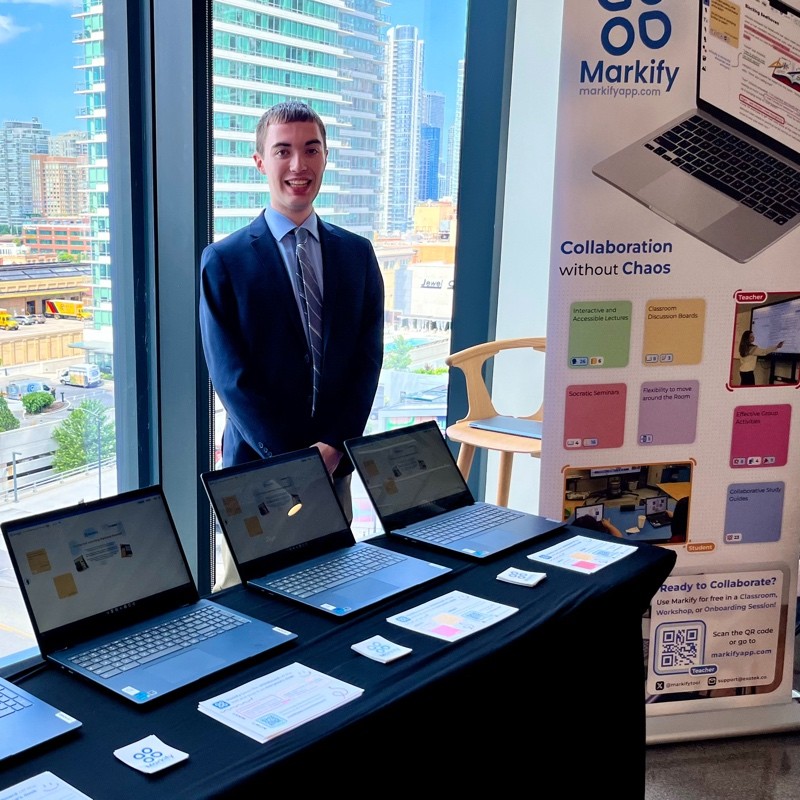
Founder
Anthony Beckett is the creator of Markify, an EdTech tool transforming how classrooms collaborate and engage. After struggling to keep up with notes in high school, Anthony began building Markify as a sophomore, spending over half of his high school career bringing the idea to life. Today, Markify is used by thousands of teachers and students around the world, making classrooms more accessible by putting the whiteboard on every student's desk. Anthony has exhibited and presented at leading education conferences including ISTE and FETC, sharing his vision for technology that empowers both teachers and students. A recent high school graduate and now a college student, Anthony continues to grow Markify with the mission of making learning more inclusive, interactive, and collaborative.